Advertisement
You have found the perfect car, negotiated the dealer discount, and now you face the final hurdle: financing.
The dealer is pushing their in-house auto loan, but your salary account bank just sent you an SMS offering a "pre-approved personal loan in 10 seconds." Which one should you choose? Is a personal loan better, or should you stick with a traditional car loan?
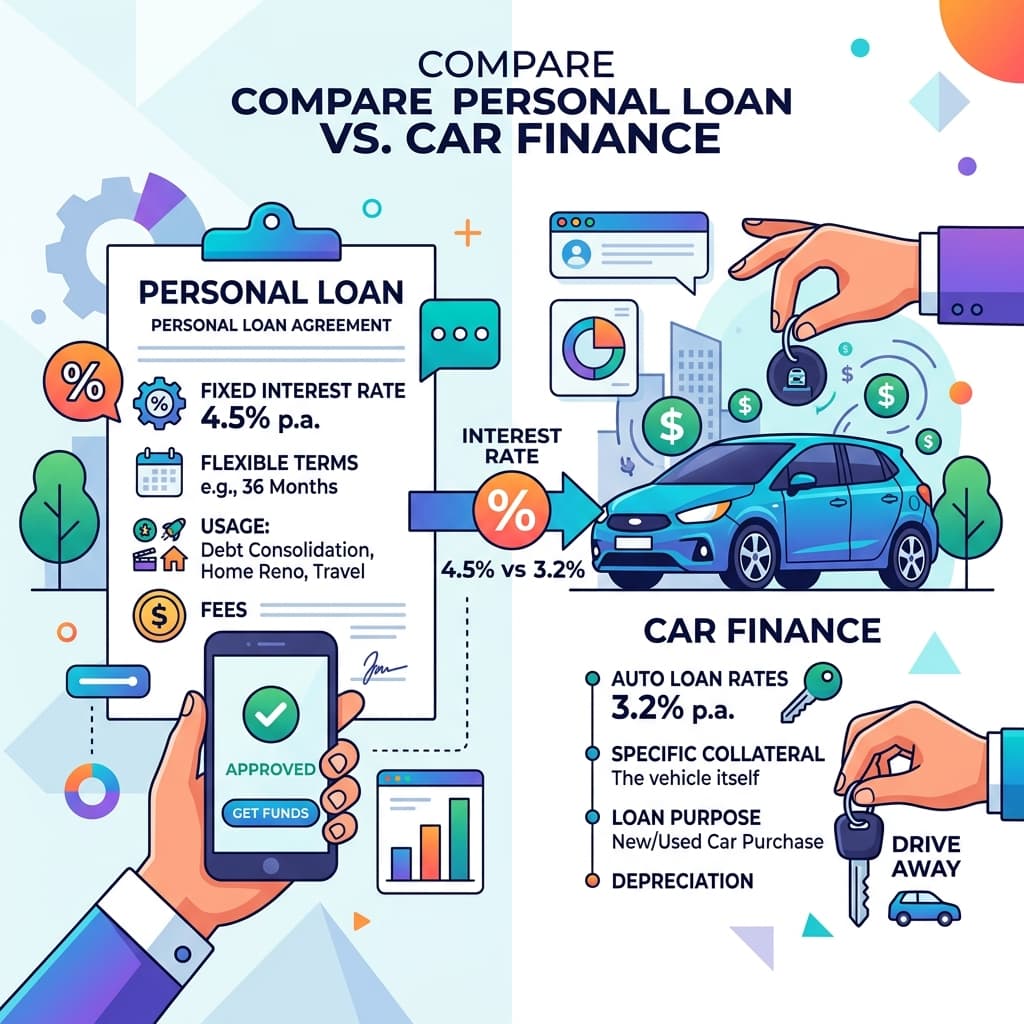
While both loans put keys in your hand, they are fundamentally different financial products. A car loan is a secured loan (the bank owns the car until you pay it off), while a personal loan is an unsecured loan (backed only by your credit score and salary). This single difference dramatically changes the interest rates, processing fees, and foreclosure rules you will face.
Key Takeaway: The Quick Answer
- Car Loans are mathematically cheaper. Because the car acts as collateral, banks face lower risk and offer lower interest rates (typically 8.5% to 10.5%).
- Personal Loans are faster but more expensive. Without collateral, banks charge higher interest (typically 10.5% to 16%) to offset their risk.
- The Exception: If you are buying a used car older than 5 years, banks often reject car loan applications or charge exorbitant rates. In this specific scenario, a personal loan might actually be the better choice.
Comparing the True Interest Rates
When comparing these two loans, you cannot just look at the headline interest rate. You must look at the total cost of borrowing. Let’s break down the typical interest rate structures in India right now.
The Car Loan Advantage
Because a car loan is secured by the asset itself, banks feel safe. If you stop paying your EMIs, the bank will simply repossess the car, sell it, and recover their money.
Due to this low risk, car loan interest rates are highly competitive. As of 2026, a borrower with a CIBIL score above 750 can easily secure a new car loan at 8.5% to 9.5% annually.
The Personal Loan Premium
A personal loan is completely unsecured. If you default, the bank has no physical asset to seize; they only have legal recourse, which is messy and expensive.
To compensate for this massive risk, personal loans command a premium. Even with an excellent credit score, you are likely looking at rates between 10.5% to 13.5%. If your credit score is average, those rates can easily spike to 15% or 16%.
Practical Example: The Car Financing Dilemma
You are buying a ₹10 Lakh car.
- Option A (Personal Loan): Because it is an unsecured loan (the bank has no collateral), they charge you 14% interest. Over 5 years, you will pay ₹3.9 Lakhs in interest. However, the car is instantly registered in your name without hypothecation.
- Option B (Auto Loan): Because the car acts as collateral, the bank feels safe and charges only 8.5% interest. Over 5 years, you pay just ₹2.3 Lakhs in interest. The bank holds the RC book hypothecation until the loan is cleared.
Unless you are buying a 10-year-old used car that banks refuse to finance, the Auto Loan always wins.
Real-World Math: The ₹10 Lakh Showdown
Let’s see how a 2% difference in interest rates impacts your wallet in real life.
Suppose you want to borrow ₹10 Lakhs for a 5-year tenure (60 months) to buy a mid-size SUV.
Scenario A: The Car Loan (at 9%)
- Monthly EMI: ₹20,758
- Total Interest Paid: ₹2.45 Lakhs
Scenario B: The Personal Loan (at 12.5%)
- Monthly EMI: ₹22,498
- Total Interest Paid: ₹3.50 Lakhs
By choosing the personal loan for convenience, you are throwing away over ₹1,00,000 in unnecessary interest charges over 5 years.
Want to compare your exact offers side-by-side? Use our Loan Comparison Tool below:
Hidden Traps Beyond the Interest Rate
Interest isn't the only metric that matters. You must also compare the hidden terms and conditions:
1. Processing Fees
- Car Loans: Typically charge 0.5% to 1% of the loan amount, but this is frequently waived during festive seasons (like Diwali) as a promotional offer.
- Personal Loans: Usually charge a flat 1% to 2% processing fee plus GST, and it is rarely waived. On a ₹10 Lakh loan, that's an immediate ₹11,800 lost to fees.
2. Foreclosure (Prepayment) Penalties
- Car Loans: If you want to pay off the loan early (say, in year 3), most banks will charge a foreclosure penalty of 2% to 5% on the outstanding principal.
- Personal Loans: Foreclosure rules are notoriously strict. Many banks explicitly forbid prepaying a personal loan for the first 12 months, and then charge a hefty 4% to 5% penalty when you finally do.
3. Ownership and Hypothecation
- Car Loans: The car is hypothecated to the bank. The bank's name is legally printed on your RC (Registration Certificate). When you finish the loan, you must jump through RTO hoops to get the hypothecation removed.
- Personal Loans: You are the 100% legal owner of the car from Day 1. There is no bank hypothecation on the RC. You can sell the car whenever you want without asking the bank for permission.
When Does a Personal Loan Actually Make Sense?
While the math heavily favors car loans, there are three specific scenarios where taking a personal loan to buy a vehicle is actually the smarter move:
- Buying an Older Used Car: Banks hate financing cars that are more than 5 to 7 years old. If they do approve it, the interest rates often jump to 14% or 15%. A personal loan might actually be cheaper here.
- Buying from a Friend/Relative: Traditional car loans require a massive amount of paperwork (dealer invoices, valuation reports). If you are buying your uncle's car for cash, a quick personal loan bypasses the red tape.
- 100% On-Road Funding: Car loans usually only finance 80% to 90% of the car's on-road price. You must pay the remaining 10% to 20% out of pocket as a down payment. If you have absolutely zero savings for a down payment, a personal loan can cover 100% of the cost (though we strongly advise against buying a car with zero savings!).
Frequently Asked Questions
Will a personal loan impact my CIBIL score differently than a car loan?
No. Both are installment loans and both impact your CIBIL score the same way. Paying either loan on time will build your credit history, while missing an EMI on either will damage it.
Can I get tax benefits on a car loan?
If you are a salaried employee buying a car for personal use, there are zero tax benefits. However, if you are a business owner or self-employed professional, you can claim the interest paid on the car loan as a business expense, and claim depreciation on the vehicle under Section 32 of the Income Tax Act.
Is it better to just pay cash?
Mathematically, yes. Cars are depreciating assets. Taking a loan (and paying interest) to buy an asset that goes down in value every single day is a double financial hit. If you can wait and save cash, that is always the optimal choice.
Action Steps: How to Secure the Best Rate
- Check Pre-Approved Offers First: Log into your primary salary account's net banking portal. Banks reserve their lowest interest rates (and zero processing fees) for their existing, loyal customers.
- Compare Dealer Finance: Dealerships may receive commissions for arranging loans. It is advisable to compare their quote against independent offers from banks like SBI or Bank of Baroda.
- Keep the Tenure Short: Never stretch a car loan beyond 5 years. If you need a 7-year loan to afford the EMI, you are buying too much car.
Related Reading
- The True Cost of Lifestyle Inflation and How to Stop It
- How to Build a Financial Safety Net in 90 Days
- Fixed Deposit vs Recurring Deposit: Which to Choose?
Frequently Asked Questions (FAQs)
What is the core concept behind personal loan vs car loan which is actually cheaper?
Should you take a car loan or use a personal loan to buy a vehicle? We break down the true interest rates, hidden fees, and when one is mathematically superior to the other.
Can you explain: Comparing the True Interest Rates?
When comparing these two loans, you cannot just look at the headline interest rate.
Can you explain: Real-World Math: The ₹10 Lakh Showdown?
Let’s see how a 2% difference in interest rates impacts your wallet in real life..
Grow Your Service Business Online
Spend less time managing appointments and more time growing your business. Accept appointments 24/7, manage walk-ins, schedule staff, and track revenue from one place.
Put this into practice
Use our free interactive calculators to plan every aspect of your finances.
Table of Contents
- Comparing the True Interest Rates
- The Car Loan Advantage
- The Personal Loan Premium
- Practical Example: The Car Financing Dilemma
- Real-World Math: The ₹10 Lakh Showdown
- Hidden Traps Beyond the Interest Rate
- 1. Processing Fees
- 2. Foreclosure (Prepayment) Penalties
- 3. Ownership and Hypothecation
- When Does a Personal Loan Actually Make Sense?
- Frequently Asked Questions
- Will a personal loan impact my CIBIL score differently than a car loan?
- Can I get tax benefits on a car loan?
- Is it better to just pay cash?
- Action Steps: How to Secure the Best Rate
- Related Reading
- Frequently Asked Questions (FAQs)
Myat Finance Editorial Team
Financial EducatorsThe Myat Finance editorial team consists of dedicated financial analysts, developers, and educators. Our mission is to make personal finance in India transparent, mathematical, and free from mis-selling. We build data-driven tools and write unbiased guides to help you make smarter money decisions.
Compare Top Loan Offers
Bajaj Finserv
Fast Loan Approvals
TTGO E-Bikes
Commute & Save Money
Disclosure:These are unbiased affiliate links. We may earn a commission if you open an account, at no extra cost to you. We recommend comparing platforms and selecting the one that best fits your financial needs.
You May Also Like
More articles about Loans & Debt Management

Home Loan EMI on ₹40 Lakh: The Complete Breakdown

How to Get Out of a Debt Trap: A Step-by-Step Recovery Plan

How to Negotiate a Lower Interest Rate on Your Existing Loan
Was this article helpful?
Financial Insights & Tool Updates
Get practical breakdowns of tax changes, new calculators, and personal finance strategies directly in your inbox.