Advertisement
Credit cards are fantastic financial tools if you pay the total due in full every single month. But the moment you carry a balance into the next month, you are stepping into a financial trap designed to drain your wealth.
If you find yourself stuck with a massive ₹3 Lakh credit card bill that you cannot pay off immediately, you have two choices:
- Pay the "Minimum Amount Due" and let the rest roll over on the credit card.
- Take an unsecured Personal Loan for ₹3 Lakhs, pay off the credit card completely, and then pay EMIs on the personal loan.
Which option is mathematically cheaper? The answer is not even close.
Key Takeaways
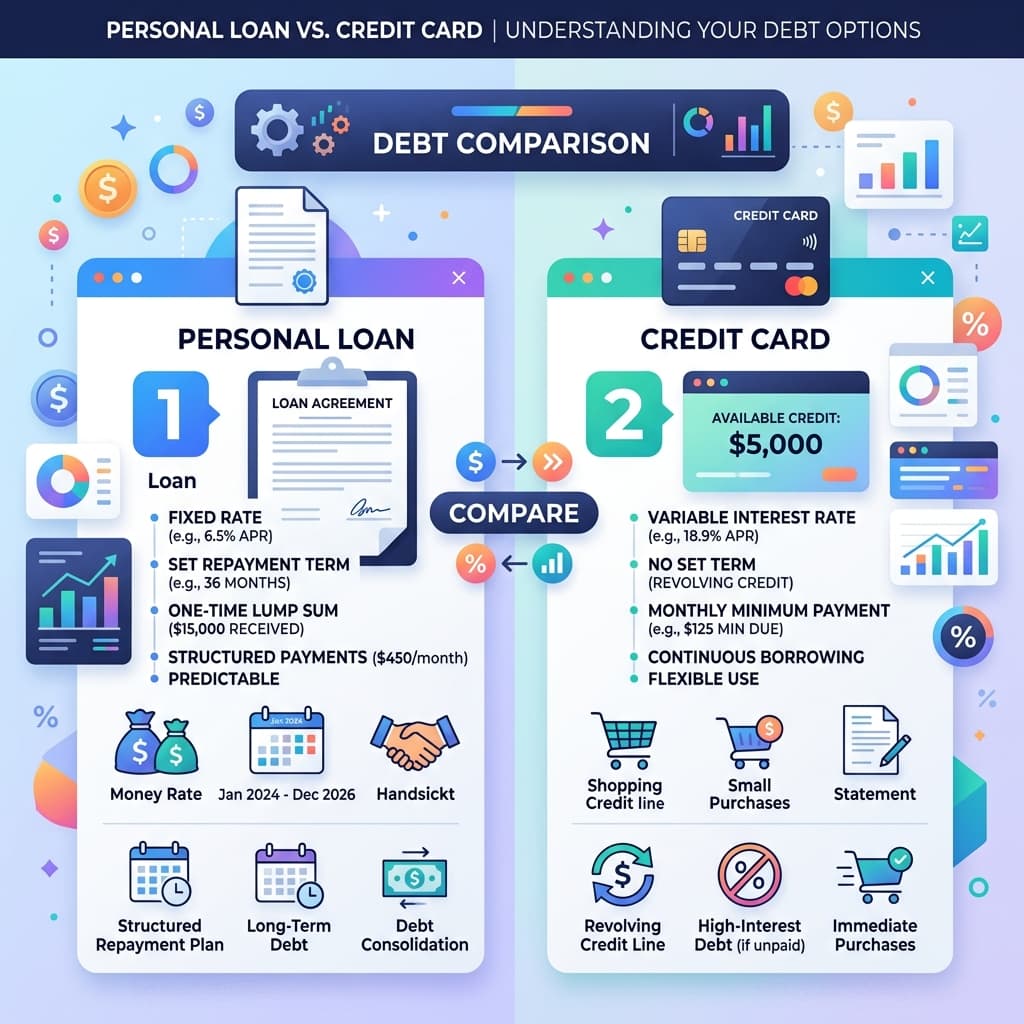
- Interest Rate Gap: Credit card debt is the most expensive legal debt in India, typically costing 36% to 42% annually. A personal loan usually costs 11% to 18%.
- The Compound Interest Trap: Credit cards compound interest daily. Personal loans use a standard monthly reducing balance method.
- The Verdict: A personal loan is always the cheaper option to consolidate and crush credit card debt.
1. The Horror of Credit Card Interest (36%+ p.a.)
When you don't pay your full credit card bill, the bank applies an interest charge (Finance Charge) on the outstanding balance.
If you look at your credit card statement, the interest rate usually says something like "3.5% per month." Because our brains are bad at math, 3.5% doesn't sound dangerous. But 3.5% per month equates to an annualized percentage rate (APR) of 42% p.a.
Worse, credit cards compound this interest on a daily basis. Furthermore, once you carry a balance, you lose your interest-free grace period. Every new purchase you make on that card instantly starts accruing 42% interest from day one.
2. The Personal Loan Alternative (11% to 18% p.a.)
A personal loan is also unsecured debt, but it operates on a standard EMI structure.
If you have a decent CIBIL score (750+), you can easily get a personal loan from a major bank at around 12% to 15% p.a.
While 15% is still expensive (it's bad debt), it is roughly one-third the cost of credit card debt.
3. The Mathematical Comparison
Let's assume you have a ₹3,00,000 outstanding credit card bill. You can only afford to pay about ₹10,000 a month toward this debt.
Scenario A: The Credit Card Route (At 40% p.a.) If you pay ₹10,000 a month toward a ₹3 Lakh balance at 40% interest, you will never pay off the debt. The interest generated every month (approx ₹10,000) will eat your entire payment. You are trapped forever.
Scenario B: The Personal Loan Route (At 15% p.a.) You take a ₹3 Lakh personal loan at 15% for 3 years (36 months). Your EMI will be roughly ₹10,399. In 36 months, you will be completely debt-free. You will pay a total of ₹74,383 in interest to the bank.
By converting the credit card debt into a personal loan, you save yourself from infinite debt and cap your interest payout.
To compare these scenarios with your own outstanding balances, use our Debt Consolidation Calculator:
4. The Debt Consolidation Strategy
If you are trapped in credit card debt, here is the exact playbook to get out:
- Stop Spending: Remove the credit card from your digital wallets (Apple Pay, GPay) and freeze the physical card.
- Apply for a Personal Loan: Apply for a personal loan equal to your exact credit card outstanding amount.
- The Transfer: The moment the personal loan hits your savings account, immediately transfer 100% of it to the credit card to bring the balance to zero.
- The Discipline: Treat the personal loan EMI as a non-negotiable monthly expense. Do NOT use the credit card again until the personal loan is fully cleared.
To figure out the mathematically fastest way to pay down multiple debts (Avalanche vs Snowball method), use our Debt Payoff Planner:
Action Steps
- Check your credit card statement today. If you are paying Finance Charges, you are bleeding money.
- Check your CIBIL score. If it's above 720, check your banking app for pre-approved personal loans. HDFC, ICICI, and SBI often offer "one-click" personal loans to existing customers at reasonable rates.
Related Reading
- The Hidden Cost of Minimum Credit Card Payments
- Is a Credit Card Balance Transfer a Good Idea?
- Gold Loan vs Personal Loan: Which is Better in an Emergency?
Frequently Asked Questions (FAQs)
What is the core concept behind personal loan vs credit card which debt is cheaper?
Stuck with high credit card bills? We mathematically compare rolling over credit card debt versus taking a personal loan to consolidate it.
Can you explain: 1. The Horror of Credit Card Interest (36%+ p.a.)?
When you don't pay your full credit card bill, the bank applies an interest charge (Finance Charge) on the outstanding balance..
Can you explain: 2. The Personal Loan Alternative (11% to 18% p.a.)?
A personal loan is also unsecured debt, but it operates on a standard EMI structure..
Grow Your Service Business Online
Spend less time managing appointments and more time growing your business. Accept appointments 24/7, manage walk-ins, schedule staff, and track revenue from one place.
Put this into practice
Use our free interactive calculators to plan every aspect of your finances.
Table of Contents
Myat Finance Editorial Team
Financial EducatorsThe Myat Finance editorial team consists of dedicated financial analysts, developers, and educators. Our mission is to make personal finance in India transparent, mathematical, and free from mis-selling. We build data-driven tools and write unbiased guides to help you make smarter money decisions.
Compare Top Credit Cards
Tata Neu Card
Best for Tata Brands
Bajaj Finserv
Fast Loan Approvals
TTGO E-Bikes
Commute & Save Money
SBI Credit Card
Great Rewards & Offers
Disclosure:These are unbiased affiliate links. We may earn a commission if you open an account, at no extra cost to you. We recommend comparing platforms and selecting the one that best fits your financial needs.
You May Also Like
More articles about Credit Cards & Personal Debt

The Best Credit Cards in India (2026): Rewards, Cashback & Travel

The No-Cost EMI & Zero APR Trap: How Free Financing Costs You Money
Is a Credit Card Balance Transfer Good? The Hidden Costs Revealed
Was this article helpful?
Financial Insights & Tool Updates
Get practical breakdowns of tax changes, new calculators, and personal finance strategies directly in your inbox.