Advertisement
Imagine you invest ₹1 Lakh in a mutual fund, wait five years, and it grows to ₹3 Lakhs. You sell it and prepare to celebrate your ₹2 Lakh profit. But before you book that vacation, the Income Tax Department knocks on your door.
Welcome to the world of Capital Gains Tax.
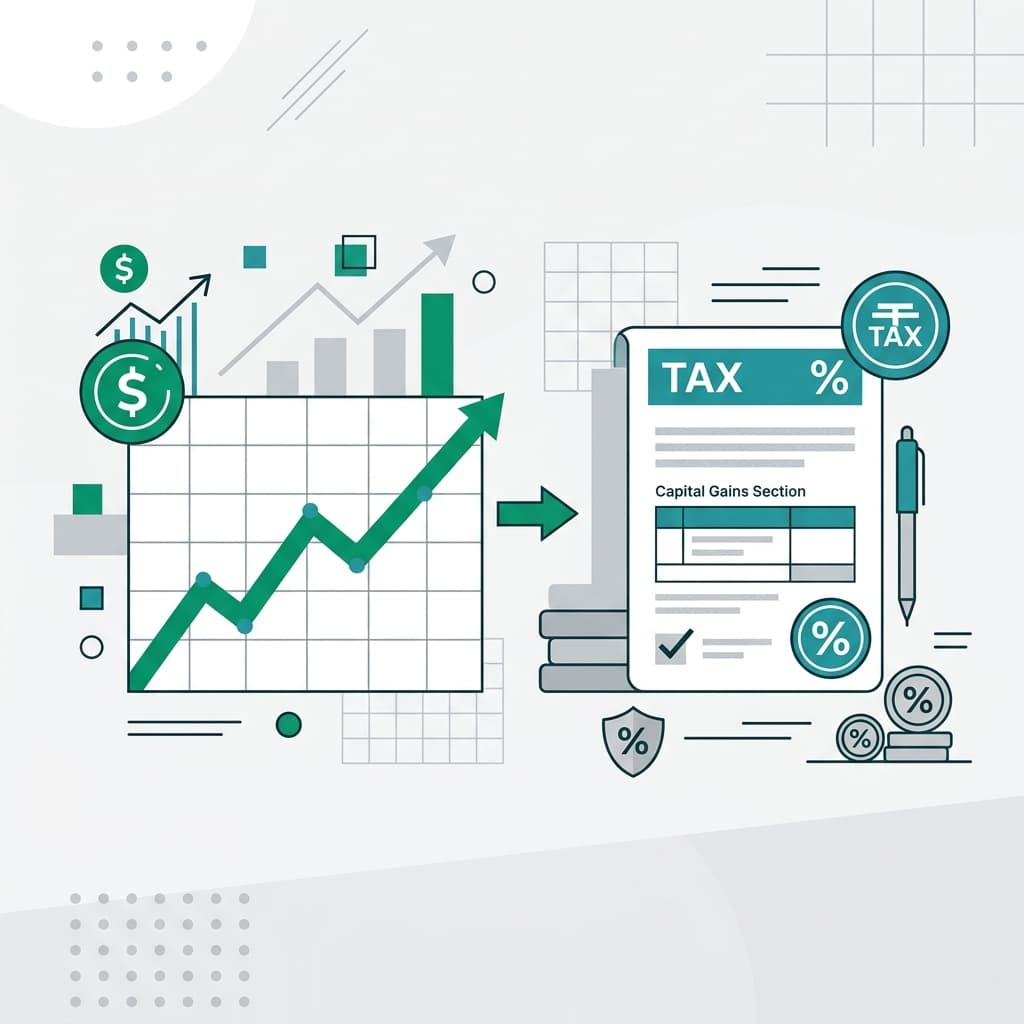
Any profit you make from selling a "capital asset",such as stocks, mutual funds, gold, or real estate,is classified as a Capital Gain. Depending on what you sold and how long you held it, the government will take a slice of your profits. Understanding exactly how this slice is calculated is the secret to keeping more of your hard-earned wealth.
Key Takeaways
- Equity (Stocks & Equity Mutual Funds): If sold within 1 year, Short-Term Capital Gains (STCG) tax is 15%. If held for >1 year, Long-Term Capital Gains (LTCG) is 10% (on profits exceeding ₹1 Lakh per year).
- Debt Mutual Funds: As of April 1, 2023, all debt mutual funds are taxed at your income tax slab rate, regardless of the holding period. There is no LTCG benefit.
- Real Estate: Sold within 2 years = STCG (slab rate). Sold after 2 years = LTCG at 20% with indexation benefits.
- ₹1 Lakh Exemption: You can legally harvest up to ₹1 Lakh of long-term equity profits completely tax-free every single financial year.
1. Short-Term vs Long-Term (The Holding Period)
The government incentivizes long-term investing. The longer you hold an asset, the lower your tax rate will generally be. The defining line between "Short-Term" and "Long-Term" depends entirely on the asset class:
- Equity (Stocks & Equity MFs): 12 Months
- Real Estate: 24 Months
- Gold & Unlisted Shares: 36 Months
If you sell before this period, you pay Short-Term Capital Gains (STCG) tax. If you sell after this period, you pay Long-Term Capital Gains (LTCG) tax.
2. Tax on Equity (Stocks & Equity Mutual Funds)
To qualify as an Equity Mutual Fund, a fund must invest at least 65% of its portfolio in domestic Indian stocks. (This includes index funds like Nifty 50).
Short-Term Capital Gains (STCG)
If you buy shares and sell them within 12 months, your profit is taxed at a flat rate of 15%, plus applicable cess and surcharge. It doesn't matter if your salary is in the 5% bracket or the 30% bracket,STCG on equity is always 15%.
Long-Term Capital Gains (LTCG)
If you hold the shares for more than 12 months, your profit is taxed at 10%. However, there is a massive loophole here: The first ₹1 Lakh of long-term equity profit every financial year is 100% tax-free.
Example: You sell stocks after 3 years and make a profit of ₹1.5 Lakhs. You will pay 0% tax on the first ₹1 Lakh, and 10% tax only on the remaining ₹50,000 (Tax = ₹5,000).
3. Tax on Debt Mutual Funds (The 2023 Rule Change)
Before April 2023, Debt Mutual Funds were the ultimate tax-saving hack. If you held them for more than 3 years, you got a flat 20% tax rate with indexation (which practically brought the tax down to single digits).
The New Rule: For any Debt Mutual Fund (where equity exposure is <35%) bought after April 1, 2023, there is no concept of STCG or LTCG. The entire profit is simply added to your income and taxed at your income tax slab rate.
If you are in the 30% bracket, your debt fund profits are taxed at 30%, whether you hold them for 1 month or 10 years. Because of this, many investors are moving their conservative money back into Fixed Deposits (since the tax treatment is now identical).
4. Tax on Real Estate (Property)
Selling a house involves massive amounts of money, and the tax implications are equally massive.
STCG on Property (< 24 Months)
If you buy a house and sell it within 2 years, the entire profit is added to your income and taxed at your slab rate. (If you make a ₹20 Lakh profit and are in the 30% slab, you owe the government ₹6 Lakhs).
LTCG on Property (> 24 Months)
If you hold the property for more than 2 years, the profit is taxed at 20%. However, Real Estate offers a superpower called Indexation. The government acknowledges that inflation eats away at the value of money over time. Indexation allows you to artificially inflate your "purchase price" to match current inflation levels, drastically reducing your calculated profit, and thus drastically reducing your tax.
5. How to Avoid Capital Gains Tax on Real Estate
If you just sold a house and are staring at a massive 20% tax bill, the government offers two major escape routes:
- Section 54: If you use the entire profit (capital gain) to buy or construct another residential property within a specific timeframe, your tax liability becomes zero.
- Section 54EC (Capital Gains Bonds): If you don't want to buy another house, you can invest up to ₹50 Lakhs of your profit into specified government bonds (like NHAI or REC bonds). These bonds lock your money in for 5 years and pay ~5% interest, but your capital gains tax is completely wiped out.
6. Action Steps: Tax Harvesting Strategy
If you invest in stocks or equity mutual funds, you should be doing Tax Harvesting every year in March.
Since the first ₹1 Lakh of Long-Term Capital Gains is tax-free every year, you should deliberately sell enough of your winning long-term stocks to realize exactly ₹99,000 in profit. Then, immediately buy the exact same stocks back the next day.
You pay zero tax, but you have artificially increased your purchase price (lowering your future tax liability when you finally sell years down the road).
7. Related Reading
- The Ultimate Guide to Income Tax in India: Old vs New Regime
- How to Save Tax Under Section 80C, 80D, and Beyond
- Mutual Funds vs Direct Stocks: Which is Better for Beginners?
Frequently Asked Questions (FAQs)
What is the core concept behind capital gains tax explained stocks mutual funds and real estate?
Master Capital Gains Tax in India. Understand Short-Term (STCG) vs Long-Term (LTCG) tax rates for equity, debt mutual funds, and real estate for FY 2024-25.
Can you explain: 1. Short-Term vs Long-Term (The Holding Period)?
The government incentivizes long-term investing.
Can you explain: 2. Tax on Equity (Stocks & Equity Mutual Funds)?
To qualify as an Equity Mutual Fund, a fund must invest at least 65% of its portfolio in domestic Indian stocks.
Disclaimer: The content provided in this article is for educational and informational purposes only and does not constitute financial, investment, or tax advice. Always consult with a certified financial advisor or a registered tax consultant before making any financial decisions or filing your taxes.
Grow Your Service Business Online
Spend less time managing appointments and more time growing your business. Accept appointments 24/7, manage walk-ins, schedule staff, and track revenue from one place.
Put this into practice
Use our free interactive calculators to plan every aspect of your finances.
Table of Contents
- 1. Short-Term vs Long-Term (The Holding Period)
- 2. Tax on Equity (Stocks & Equity Mutual Funds)
- Short-Term Capital Gains (STCG)
- Long-Term Capital Gains (LTCG)
- 3. Tax on Debt Mutual Funds (The 2023 Rule Change)
- 4. Tax on Real Estate (Property)
- STCG on Property (< 24 Months)
- LTCG on Property (> 24 Months)
- 5. How to Avoid Capital Gains Tax on Real Estate
- 6. Action Steps: Tax Harvesting Strategy
- 7. Related Reading
- Frequently Asked Questions (FAQs)
Myat Finance Editorial Team
Financial EducatorsThe Myat Finance editorial team consists of dedicated financial analysts, developers, and educators. Our mission is to make personal finance in India transparent, mathematical, and free from mis-selling. We build data-driven tools and write unbiased guides to help you make smarter money decisions.
Top ITR Filing Services
Disclosure:These are unbiased affiliate links. We may earn a commission if you open an account, at no extra cost to you. We recommend comparing platforms and selecting the one that best fits your financial needs.
You May Also Like
More articles about Taxation & Tax Planning

Evaluating Tax Filing Platforms in India: ClearTax vs. Quicko (2026)

NRI Taxation: How to Calculate Tax on NRE and NRO Accounts

How is F&O and Derivative Income Taxed in India?
Was this article helpful?
Financial Insights & Tool Updates
Get practical breakdowns of tax changes, new calculators, and personal finance strategies directly in your inbox.